Why the Blog......

9 years now into the blog, and lots and lots posts on the SWOFFING (Salt Water Fly FishING) in and around Darwin - maps, flies, outings and musings

Hope your enjoying it!

Showing posts with label fly fishing tactics. Show all posts

Thursday, December 25, 2014

If you can take the heat - great fishing to be had

On the water by 6am
Hot and humid already
A very high cloud mass of a storm is easily seen in the predawn light to the north of the city of Darwin, it has heaps of lightning and rolling thunder. Shouldn’t impact us and our endeavours for a morning’s SWOFFING.


Based on my outing two days ago we are heading straight to Lee Point to fishing the dropping tide.
Hopefully the baitfish will be present and being corralled against the lines of reef, one to three hundred metres offshore of Lee Point by queenfish, trevally, tarpon and macks. We didn't find any tarpon but we are not complaining! (keep reading to see why!)

The water is a little rough - most likely after effects from the series of the nightly coastal storms common this time of year, this morning’s was currently moving offshore to the west.

We get side tracked a few times by working birds on the way to Lee Point- mostly small grey mackerel schools that are very flighty and inconsistent in their movements, and getting anywhere close to the feeding macks, and the birds above them, sees them dispersing faster than we can get there - quite frustrating. Regular deckie, Peter and I call them one of the ‘MMMM’ fish (Maddening Mullet Mackerel and Milkfish) in other words fish that frustrate us when targeting them (usually for no result!).

We catch a virtual aquarium full of species at the various rock bars along the way to Lee Point - but no size - all tiddlers if quite colourful and various. Stripies, baby blue bones, mouth almightys, baby coral trout, and 10 other species I have no idea what they are named. 

On our eventual arrival at Lee Point the wind is dissipating, the water was also calming by the minute, and the birds are working in large flocks in several locations nearby. The unique type of sporadic slashes and splashes on the water’s surface clearly indicate mackerel again. But they are all over the place. Up and down before we can even move to chase at times. Even though and despite being an MMMM fish, we give chase, and we chase, and we get the occasional cast in when they are too busy to notice our approach, and we even get a few macks to hand.
We manage (that is fluke) a few other fish or two. A good queenie, a small giant trevally. I get one good queenie that goes nuts zipping all over the place, then we see the brown smudge of a shark chasing it explaining why it was acting such. I let the drag way off and the queenie alludes the shark but once back into the fight and tight lines again - the shark and this time a mate return. The first shark takes the back half of the 60cm queenie in a cloud of bursting redness. The second shark takes the rest and my fly, my backing streams off rapidly and we are about to give chase when the 20lb leader parts as would be expected with a 3m plus sharp toothed reef shark is connected to you on a mono leader. 

It is now I realize I left my cap that has the head mount for my action cam on the kitchen bench at home – it would have been great to get that action on video! Lucky I brought the railing mounting clip for the cam.

Once a vast pack of 60 -70cm plus queenies hangs under the boat for a while - following flies but not eating them. BUGGER! an awesome sight seeing so many queenies is such crystal clear water.

Questions arise as to fly choice - size colour action, materials - anything to improve the hook up results. We hedge our bets and fish a few different flies. I settle on the 'no see um' mini calf tail clouser baitfish imitation in size #1 and get good hook up rate. But I also used 50mm long surf candies in blue/white, and also in chartreuse/white, for good results too. The queenies seemed very keen on the chartreuse/white surf candy while the trevs liked the tiny white clouser. The macks didn't seemed to care and frustrated our fly experiments by ignoring whatever we cast to them, then a minute later took the same fly with carefree abandon.

We come across a bit of a pressure wave readily seen in the almost calm conditions – most likely caused by the outgoing tide pressing around and over a submerged rocky reef - on the bottom corner of the reef as the tide  flows, fish at constantly busting up the surface attacking the baitfish, along the back and front of the reef more fish are devouring baitfish with abandon. The mackerel are working back and forth and we catch a few, some quite large, as they come within casting range of our anchored boat. Due to lack of wind we can cast in any direction as the fish break the water surface to indicate where to cast to. We catch good queenies to 60cm, trevs to 45cm, and macks to 60-70cm. After a while neither of us have time to count fish caught – it is just cast, strip, “I’m on!", wind in line, net fish, de-hook, toss fish back, cast again – repeat! Over and over. Simply one of the best times we have had on the water up here in Darwin. We would have preferred some larger ones but hey, it was still awesome SWOFFING!

The action for the next 2-3 hours was epic to say the least. Constant double hook ups, rarely was a cast then retrieve done without a follow, several hits or a hook up. We actually were exhausted catching fish and sat down to drink and eat while the fish continued to bust up baitfish schools in every direction from our boat and we were too tired and sore to even put in a cast to the nearest water surface bust up.

Awesome SWOFFING to say the very least. The action was so great we switched over to surface flies for a more visual experience. To have ten to fifteen fish slam your fly in a 30m retrieve was soooo much fun, it should be illegal. Hook ups didn’t even matter. But you never went too many casts using the floating lines and crease flies without a rod getting bent to the handle!

And do you know that we never saw another boat actually fishing and all this only 30mins boat ride from the centre of Darwin city.

Yes it was hot, sweaty and humid but with iced drinks, a few nibbles of food, full and proper sun protection, and resting every now and then to sustain you in such weather conditions - the SWOFFING was out of this world.

On a side note I manage a new PB for a species – this a 68cm Long Tom, schools of them were also into the small baitfish carried along by the fast tidal flow.


The fishing finally slowed to only a few bust ups every few minutes and we thought we would try for a difference experience but with the tide very, very low we had few choices. We visited Weed Reef but I have never ever seen it that exposed and so far from the water. Wickham point too.

For the last hour or so of this outing we hang off the inside gravel bar off Shelly Island waiting for the tide to start to flow in and create a pressure wave. Just like two days ago – like  then it again had small trevs (but this time no queenies - ????) hanging off it readily taking any fly swung across and through the pressure wave.

Peter was had it physically from heat ( and I wasn't far behind) and all the fish we had caught. I had a muscle issue in my casting hand from two days of fighting heaps of fish (so sad isn’t it!).

So, we called it a day and dragged the boat out of the water and headed home – very pleased with ourselves.

I also had permission from the wife to fish the next day (24th Dec) but I was so fulfilled with my SWOFFING (and physically sore), I stayed home and tied 60 or so more surf candies and 30 tiny white calf tail based clousers.

One bit of bad news, on removing bungs from boat back at home after this outing, almost 60-100 litres of water streams out almost what seemed endlessly from inside the boat. Crap and bugger me!

Seems I have another crack in my hull to be re-welded. That means no boat based SWOFFING for a while.

So the next few blogs will be focusing on boat repair updates and fly tying – might finally do the tying sequences for that Gold Bomber Fly I have promised too many times!

Finally, based on this outing, I suggest despite the hot and humid weather conditions – cover up for the sun, have plenty of fluids (water not beer!) and go catch some fish -  preferably with  flies  you have made yourself!

a boring video on the day's surface action


Wednesday, December 24, 2014

Darwin Harbour (20141221) with visiting son and his girlfriend

Quite an overcast morning with storm and lighting off to the north
Luckily this storm passed around us much to the relief of my son Bradley and his girlfriend (Casey) visiting from Sydney. Given it was Casey's first  time to Darwin, she was still pretty enough paranoid just about Crocs jumping into the low profile boat I have but I assured her I had not seen any in the harbour for quite a while (funnily I did see a 3.5m one off East Point two days later!).

After a quick ‘look see’ at Shelly Island and Wickham point for naught surface action wise, we popped over to Weed Reef

We got a few smallish giant trevally but nothing consistent. With the wind dying back to almost nothing, we then crossed back over harbour for Katlyn Bay.
                                                                                                             
I was hoping to maybe find the Golden Trevally I have found in the bay previous trips but alas no Goldens this day. When first there, there were  a few medium sized Milkies (70cm or so) hoovering down algae scum off surface in one corner of the bay. However, given my guests were not SWOFFING nuts like myself, I left the harder to catch Milkies alone and instead we chased the small queenies marauding some very small bait at the other end of the bay.

The baitfish being attacked were smaller than I have seen before, only about 3-4mm deep in the body and about 35 to 40mm long. My son was using a small as possible soft plastic but could not match the hatch size wise and still have something with enough weight to cast on the threadline outfit he was using (seems he has forgotten all the fly casting I taught him when I was married to his mum 15 years ago - but then again he was only five at the time!).
So I place a small ball sinker onto his 20lb leader that was tied to his main braid line and tied on a small calf tail based clouser onto his rig. Instant success to say the least. Even his girlfriend (not at all a fisher person on her own account) caught a couple of the small but plentiful skinnies continually bursting the surface with frenzied feeding activity.


Wanting something larger for them to tangle with, we headed towards East Point but nothing seen there so continued on to Lee Point.

As soon as we got to the reefs of Lee Point, a tight pack of about 20 sea birds could be seen working the pressure wave edge created by the dropping tide as it pushed up against the rocky outcrops that parallel the Lee Point headland. We caught some nice 30-40cm GTs and some 50cm queenies while casting to the water under the squawking hovering birds. However, the stiffling hot and humid conditions as well as the fight between wind and tide creating a rocky motion in the boat, got the best of Casey and so I headed back into the harbour dropping her off at Nightcliff Jetty where  my wife picked her up and took her home. The son and I headed the boat towards  the boat ramp at East Arm to meet them at home.

However the tide was way way out 0.5m and the ramp was high and dry. Giving at least an hour before we could even think about hauling the boat out of the water.
Great! More fishing.

We popped back to other side of harbour to Weed Reef again. I haven't been on the harbour at such a low time and we saw reefs and sand bars that I didn't know were even there. At Weed Reef we managed a heap of small trevally – (Giant and Fringed Finned). There were also heaps of really big (and I mean big mother big!) Milkies actively feeding the area. These were not working in waves sucking down algae off the surface but viciously slashing and turning to get at whatever they were eating. They were not interested in the algae flies I have caught them on before, nor the tiny white clousers cast repeatedly in their direction after a boil on the surface used in the hope they were eating the tiny baitfish we had seen earlier in the day at Katlyn Bay. I have had a large Milkie off Lee Point take a large clouser (lost that one as quick as I  hooked it!) while chasing queenies, so they do take flies other than scum  flies.

Frustrating ourselves with these big Milkies eventually saw us heading back to take the boat out but a short stop at Wickham Point gave us some more mini GT action and queenies to delay going to the boat ramp. This occupied us for about an hour. Eventually seeing the time was way after we should have been back, we again started towards the boat ramp at East Point.

However, when zipping past the wharf side of Shelly Island we saw a heap of slashes and bust ups on the surface off the corner of the island this had us stopping for another few casts (or twenty!). Two hours later we eventually headed for the boat ramp, as it took that long for the action to slow down (it wasn't because I was worn out and too old for catching fish as my son suggested!)

The water on this side of the small island near the loading wharf comes from deep water up over the shallow rock bar on this side and goes back down into more deep water. The effect on the water created all sorts of  pressure waves and turbulence – one that must disorientate the baitfish making them easy prey for predatory fish like the GTs and queenies patrolling this stretch of water.
see diagram here abouts for location tips


Cast after cast received hits and takes - giving bent rods and heaps of laughter and smiles from us both enjoying some good father/son bonding. It was great action in the strong flowing incoming tide – for which the hooked fish used well to their advantage to make them seem much bigger than what actually came to hand.

My son and I had an absolute blast casting our flies into the the tip of the disturbed water and letting the flies drift along the face of the pressure wave before starting a staccato type retrieve. Every cast receive some sort of attention. Many, many times we had double hook ups  and raced each other to get the fish in and cast before the other could. We didn't keep score, just enjoyed the constant action and father/son rivalry ---  AND HEAPS OF SLEDGING! over dropped fish or a retrieve that didn't get a take from the frenzied fish.

One fish my son caught a 40cm queenie with a couple of small bites out of its back (quite recently from looking at wound). Which was quite interesting to my son who had to take a picture of it.


So a slowish day to start with but still lots of fun and a few fish from each spot we gave a cast or two - that ended in a great last couple of hours for the trip of non-stop ‘a-cast-a-fish’ action.

Here is a bit of a video clip of the days trip.
             

I will be out again in two days time with my regular fly fishing deckie Canadian Peter Cooke.
Blog report and a bit of video on that outing - up on this blog soon.

Friday, September 26, 2014

BSSS Day 2 report

BSSS Day 2 - (sorry not a lot of pictures as just average size fish caught, lots of them and too busy chasing points for the comp - even forgot to turn my head cam on!)

Again up at 5:30am, wide open throttle by 6:15am (the deckie needed a hot coffee today!)
The species for the day were: mackerel, any trevally (Golden, GT, Tea-leaf etc all frequent Bynoe Harbour), barramundi, threadfin, and tuna. Now the tuna would be very difficult given time of year, but two species could be targeted in the same area, as well as two other. Flats for barra and threadies, reefs/rock bars for the macks and trevally (well GTs anyway).
We made for Simms reef for the macks of yesterday but frustratingly nothing for first 2 hours.

We saw a little splash on shallow side of Simms reef and after watching this for 10-15 minutes finally went over to get at least something even if tiny small as the splashes seemed to indicate.
However, once there, the water was excitingly boiling with fish and we had 45 minutes of fish after fish. GTs to 38 cm and queenies to 45cm mixed together in a patch of 2m deep water behind a sand/gravel bar. The deckie was really enjoying himself (so was I). The water tidal flow created an eddy as it curled over and around the sand bar and the fish were boiling the water with their feeding activity. There were some small macks too, but we didn't manage to get hook them. Once the water dropped a bit more (25-30 minutes later) the action died off just as quick. We moved  back to front to the occasional large slash of fish along a tide line but nothing consistent and for an hour casting no result.

The water on Sunday was mirror calm, no wind - making it quite hot. Something we hadn't experience in quite a few months. The sweat was beading down our backs as we were casting and trying all sorts of retrieves to entice the macks to bite. We saw one or two slashes of a fish or two behind the flies but action was very very very slow.

Given the ultra calm conditions we decided to head into wide open water to find some working birds.
We came across 10+ adult dolphins and one baby swimming with them.  We cut the motor and watched them for 10 minutes - so graceful sliding through the water. They were in about 4 metres of water harassing some quite small 30cm grey macks (which we could catch!), this dolphin food was skipping across the surface in 5-10m skips to escape the dolphins.

A little later, we came upon some sand/gravel bars way offshore that some large queenies were  patrolling- we got follows but no takes. Awesome to see such fish in such clear and shallow water, Must visit this spot again!

Later a massive black backed ray about the size of a dining table came by and I cast to it in hope of an accompanying GT, however the two GTs that appeared off the ray's back that chased my fly caused my knees to wobble. They were absolutely huge 90+cm plus versions. Massive in shoulder thickness and body depth. Again sadly only a couple of follows was all we got - no hookups.

The rocks and ledges nearby however were covered in fish - Stripies, Moses perch, Queenfish, and sub 40cm GTs. The deckie, thoroughly enjoying himself, got 10 or so GTs in 15 or so casts with a crease fly.  He also enjoyed a shark pinching one of his fish, after this he switched to one of my mega flies to target bigger fish. The little guys were very keen to slash at the mega fly but not the big fish.

this Moses Perch that was smaller than the fly it ate!
While he was casting around trying to catch a big one, I with my small clouser (orange over white) caught a cricket score - full of stripes, Moses perch, the occasional queenfish and small GTs - all racking up the points. I too had a large shark take a 30cm fish right at the side of the boat. While it hung onto the fish, it wrapped my fly line around several reef lumps before breaking off the leader. Luckily the fly line survived the episode without any nicks.

We had another mega GT visit working along the reef edge looking for a live meal and it also chase one of the small stripies I had on the line, but saw the boat and slithered away between the structure nearby. Peter again went to the big flies for a while, I was still catching heaps of reef species one after the other, a fish almost every cast not big but lots of them. I didn't  put them all on the scoresheet as they just keep biting and I kept casting with out worrying about the scorecard. In a moment of calm, I would write a few of the lengths of fish caught down.  We had multiple double hook ups. I really enjoyed Peter working the fish into frenzy with his crease fly and I would then cast behind the fish when the popper was removed - resulting in an instant hook up on the small clouser.

Working around the reef edges we found some queenies and macks of one reef point. The wind was picking up making it hard to hold our position. As the tide was rising, I parked up on the reef and we cast to the bubbling bait off the point. I managed to snag a mackerel in the top lip, giving me two species and thus into bonus points. Up to that time we were not comp focused, mainly enjoying a great hot bite and many species. Now things changed comp wise with two species from the list.

Peter was working his hardest to catch a mack but time was short to lines out and heading back to put scorecards in on time. Peter hooked up to something good and we hoped it was a mack but it was a 50cm queenie. Peter got all loud and excited about something. When he finally calmed down it I found out it was another mega GT that took interest in his queenie making - it look like a live bait, the GT was so large.

Peter quickly measured and released the queenie and cast back to where the mega GT had moved and instantly hooked up to it. Line tore off his reel, I put electric down, pulled plumb bob anchor in and gave chase to the fast fleeing fish. The fight was intense and just as we were getting close to the fish 20 minutes later the leader parted- BUGGER! To say the least!

Given that disappointment we motored straight to the ramp to get the score cards in on time.
Both us had a great day of sighted fish, peter a few big fish on and seen - something he had been working a while on that gave him great enjoyment. With my bucket filled scorecard I was hoping to move up a few positions.

A few of the front runners of Day 1 getting their 600 point or so, I was feeling confident with my 1300 plus points for Day2 (still wishing I had gone to the flats to get a barra or threadie). In the end I managed third for the comp and for Day2, which made me mildly regret my not so good fish wise Saturday . The two in front got three species and the subsequent extra bonus points and managed 1500 plus.  points for the day.

It was a great weekend, plenty of learning curve and a heap of fish. The sighted mega GTs and queenies gave me many hopes and ideas for future trips. My flies worked well, Everyone loved the boat boxes that were donated. Lots of positives.

Not to mention - great people to fish with, as too great accommodation and food at the Sand palms motel and pub
Check out the Mobs blog site for more BSSS 2014 trip reports.
here is five minutes of the small fish action along a reef edge -


Tuesday, September 23, 2014

BSSS 2014 - Day 1 report

BSSS day one.
Arrived 8pm Friday, given the low key nature of the comp, no real Comp info session.  After chatting to various BSSS SWOFFERs fishing the comp, it managed to swiftly tick over the clock and we were in bed snoring by 11pm.
Up at 5:30 Saturday morning, we launch by 6:10am (awesome morning by the way!)


The five species for Saturday were: queenfish, any cod species, bream (pikey version up here), javelin or ock ock, and lastly blue salmon.

I really like the manner of scoring in this comp. All fish caught are worth 1 point per cm, but of the chosen five species for the day, you multiply the top five lengths by the number of the chosen species caught. For example catch 3 of the 5 chosen species and all the top five of those species are multiplied by 3. Really makes you think about where, when and how you will fish to catch those chosen species drawn from the proverbial hat list of 20 or so species. Best thing is it is all new the next day with a new five species chosen.

So we planned to fish the flat behind turtle island first up.  As we saw heaps of blues on this flat two week earlier - plus barra & queenies. But like last time the fish that were on the flat were very touchy and not interested in our offerings of clouser, full blown imitative prawns, and every other fly we could think of to no avail. Result of Location one - no score
We planned to then chase blues in a deep hole in a creek nearby after that but the tide had receded too far and we were cut off by a sand bar form the deep hole that always has blue in it, so what now? Location two, again no score.

With the sea flat and almost no wind about we popped the 15 minutes over to Simms reef for a hopeful queenfish before find some filling creeks on the rising tide to target rock bars for OckOck, the bream and an estuary cod - hopefully!

At Simms, we found no queenies but plenty of small Spanish macks willing to slash at the fly (but sadly, not stay tight to the reel)
We lost more flies than when previously catching macks, but we managed to fluke two for about 15 or so flies lost. Great! something on the scorecard

By now the wind was steadily increasing as forecast limited possible fishing locations
We decided then to chase some cod. But risking winds would change our plans. There is a rocky flat NW of Knife Is near the Paspaley pearl work base I had caught cod before so we ventured to it with hopes high. Once there we caught a few giant trevally off rock structure. We had one large cod chase after a 10cm GT, that got us excited for a bit - but all to no avail with the larger flies we cast to it
We drifted over the many rock bars and shallow reefs in this area. The deckie got a great visual catch of a 50cm queenfish hiding between two rock bars that came up to take his fly.

On one little rock platform bear Knife Island, I managed a first of species since coming to Darwin of a 40cm barracuda, which was quite novel to catch.
(insert image of cuda)

We thought we would head right to back of Bynoe to some rock bars to find fish but by time we got there the wind was atrocious for the location we tried. Given the wind was still increasing and it had been such a hard frustrating day, we headed back for an early swim in the accommodation' spool
The deckie managed about 150 or so points and was in 11th place, While I got a few more points to be in 10th place. The front runners were getting 600+ points.

The evening seemed quite short after the awesome group dinner as most were feeling the long day fishing in the wind. After the five species for the next day were drawn, I crashed into bed by 9pm, feeling it to be much much later! (Old man syndrome!)

Despite a below average day - expectations were still high for the next day.
More to come!

Friday, August 22, 2014

'Hall Pass' awarded to me, finally! - now where to go SWOFFING?

Ok, I have been a good father and husband this week and even though I have time constraints due to a an essay that is due shortly...
I have earned a 'hall pass' to go fishing this Sunday - but where to go?

Option One: Darwin harbour
The tides are ones I like - neaps tides working towards spring tides with Sunday's high of 6.4 just before sunrise at 5:55am, low of 2.4 m at midday.
This is good as I can fish first light at Weed Reef or other rock bars like Lee Point for pelagics as the tide starts to drop then fish the harbour arms for some flats species - be home just after lunch time - but hopefully action continues and I can fish the rising tide and the current lines for more pelagics till late in the afternoon.


The only minus is the wind forecast - with 5-10 knot winds first up with patches of higher and lower wind speeds varying through the day - thinking about it its not too bad of a forecast if it stays true.

Would be on the water 6:30am with the predawn light and out to Weed Reef by 6:50am, We would choose actually location we fish first by wind speed and direction and time of tide.

The next decision would be which boat ramp and that depends on where I choose to fish first up to target pelagics like queenfish and treavally - so the first fishing location is down to two places - Lee Point (as too for the bonus of possible Broadbarred Mackeral and Longtail Tuna) or Weed Reef and its usually dependable species.

If Lee Point it would be from Nightcliff but you need a 2.5m tide to retrieve the boat - so that's a mid-afternoon ramp return option with this tide which can also be a problem if wind increases and I cant put in till tide rises.

Otherwise - its East Arm ramp which is good in all but the lowest spring tides - and to take advantage of the low tide flats and other locations to fish on the way back into the harbour as the day progresses.

So option one is looking OK

Option Two: Corroboree Billabong
Tides are not the issue but water temp is - its been quite cold nights recently, down to single digits in the rural areas last week but day time temps at in low 30's. Plus it is a long drive  (am I talking myself out of this option already?).
In the positive wind is less of an issue as less intensity in an inland wind and lots of curves in the billabong to find a point get out of wind. Plus the wind can help with some very good drift lines along the edges of the lillies and weed beds

And I do love my Saratoga fishing, and if we left home at 6am we could be on the water by 8am just as the sun is warming the water. We might miss out on dawn topwater fly action which always worth a long drive but the fish will get quite active between 9am-3pm on sub surface flies and the warming water.

Option Three - Vernon Islands.
Still trying to get here again!!!!

But my inexperience and possible increasing wind have me scared off this option. It can be pretty intense wave action here due to wind and tide in between the islands - especially in my low profile boat. I might wait till the calm weather returns at beginning of the wet season for this much longed for trip. (What an old and soft wuss I am becoming!)

I will chat to my 'deckie', and a friend who might bring his boat, to decide what option we will take.

Fishing report in next blog - hopefully with some fish in it!

Wednesday, July 16, 2014

A Few Videos of SWOFFING in Darwin Harbour

Sitting in a mid-year conference, need to do something to stay awake......

Thought I might as well load a few videos of SWOFFING in Darwin harbour from over the last year


This one is my usual fishing partner (Peter) and an 83cm queenfish he caught off Lee Point earlier this year


This one is some non-stop action we had off Darwin Harbour Mandorah rock bars  (2014/04/13)

Monday, July 14, 2014

Bynoe harbour Trip Report 20140713

Arrived Saturday afternoon at the Sand Palms pub which is about 3-4km from Milne inlet boat ramp. I set up the swag out in the back paddock amongst 10 or so other tents and campers. The 25 or so members of the NT Social Fly Fisher Mob were just starting a cook up. Three woks on gas burners, finger sized cuts of fish fillets from the few fish caught that day covered in various batters and coatings to fry them up with. Add a couple of big boxes of hot potato chips - and as a big full moon rose from the eastern horizon we had the makings of a great evening sitting around in circle drinking, eating and chatting about the fly fishing of what, where, with what and why no one was catching any.

The conversations mostly involved why the sighted fish that day were not enthusiastic enough to suck down the fly presented to it. Other discussions also solved all the world's problems and even identified why the kids of today just don't get it. As you usually do when sitting in a circle and most involve continue drinking alcohol as the night wears on. While the alcohol is not my thing, it was interesting to listen and participate in the discussion's journey even though it degraded as the evening progressed.

I was in bed early at 9:30pm, however I think the talking went on a lot longer. I slept under the stars with just a mosquito net above me. It was a cold night for Darwin standards with 19 degrees Celsius, so I was happy to have a sleeping bag - normally you don't need anything as a covering during the night during dry season.  The night time stars were awesome in their display away from the glow of city lights, as too the full moon so bright that no light was needed to see what was around you.

Jim and I were up at 5am to beat the high tide of 7.4m at 6:30am filling the boat ramp's lower carpark (a trap for those not familiar with using this ramp). We motored along the rippled water under the moon light for 45minutes towards the front of Bynoe harbour to look for Pelagics at dawn. Out the front, the wind was up right from the start and the water very choppy, so spotting active Pelagics was difficult and they didn't seem to be hanging off the usually points and confluence of current places either.

We then popped into a protected corner on the front beach of Indian island to cast around some mangroves covered by the high tide. Threadfin salmon at times herd up baitfish in this back corner. But nothing was seen nor taking the blind cast flies. So we moved along casting, searching, casting, searching, changing spots. working our way back down the harbour. A difficult day loomed.

The water was different than normal, the wind frustrating, cold and warm spots in air and water - the fish almost non existent. We did see the occasional slashing fish or 'boofing' splash of bait being taking off the surface but there was no consistency. One splash here or there and then no more , maybe one to three splashes a hundred meters away but by the time you moved over there - no more activity.

Due to soft mud and the ever present crocodiles up to 4.5m that inhabit the area, we fished from the boat as opposed to wading. As the tide started to drop we started searching the flats and 'snake' drains that squiggle across the flats from drainage areas at the edge of the mangroves. We spotted one small barramundi, its tail bright as the fish moved along the edge of mangroves but a cast 6 metres in front of it spooked it, all fish seen in morning were were highly skittish.
Bucktail Baitfish

Had one good presentation at a sighted 60+cm barramundi hanging at the  corner of a snake drain. The stripped bucktail baitfish fly induced the fish to follow! The fish even had a half hearted 'boof' at the fly but failed to hook up. It brought me to my knees in despair at the missed opportunity given the lack of cooperative fish we had been finding. I felt the take, a slight tightening of the line then nothing, bugger!

This continued for most of the day. Sighted fish, stealthfully approached, carefully cast to, only to achieve refusals or half takes, missed hookups or scared off.

One interesting incident occurred that I would like to share (see video). As were cruised under the electric motor along edges, a small barra about 20cm long was chased out of the water and landed high up on the mud bank . It flipped itself several times up to 50cm into the air trying to get back into the water. By the time we arrived it was exhausted covered in mud and deathly still in the thick mud. We positioned the boat nose into the bank and used the landing net to reach out to retrieve it and revive it before releasing back into the water.


Around 2pm at bottom of tide, due to wind direction we ventured to a leeward flat on the side on Crab Claw peninsula, one I had driven past every other time fishing Bynoe on way to boat ramp. The flat was starting to be inundated with the rising tide. Baitfish could be see moving around but no predatory activity seen. There were a few gravel and rocky areas we thought we might pick up a golden snapper or mangrove jack from.
Mangrove jack from previous trip to Bynoe

Jim did hook up a mating pair of crabs that amuse us greatly but as we got close to gravel patches a large 70+cm barramundi could be seen sitting above the gravel in clearish water only just covering their back.

We surmised that the fish were warming themselves above the gravel beds that had absorbed the sun's heat during the morning. I know several other similar locations within Darwin and Bynoe harbours that I will have to visit to verify the theory before the water starts warming up in a month or so.

Prior to approaching the gravel patch, I had changed from a baitfish type fly I had been using on the snake drains to a scampi/squimp combination fly to more suit the bait found on the gravel beds - shrimp and crabs.  As I cast the flats crustacean fly to these fish, they were interested immediately - whether due to my fly or being warmed up from the solar heat in the gravel and rocks - I choose my fly tying skills - ha ha !-).


This first fish cast to could be seen reacting to the fly and chasing the fly across the bottom of the gravel patch as I skipped and paused the fly. The fish tipped head down and inhaled the fly off the bottom substrate and spat it out before I could even react. The hook point almost got purchase in the lips I could feel the contact through the flyline but the fish flicked around after picking it up and dislodged to fly. Amazingly it went straight back to its lie above the rocks (again confirming our solar heating theory?). I cast to the fish again and it followed the fly like last time. This time as it tipped and ate the fly, I strip struck the flyline and hooked up firmly, line taught, weight on with the fish boofing or inhaling the fly right into its gill rakes and it sliced the leader material as it it was cotton thread. After  a short of second, all went slack.


Man! that was fun to watch all that and understand what it was doing and why, having it take my fly chosen for the purpose.
I just love this scenario and this type of sighted flats fishing!

Jim using a baitfish profile fly, (yellow head with white feathered tail with a touch of blue flash) had two fish follow his fast staccato strip. These two fish were much bigger than others we had seen on this gravel patch and similarly to previous fish seemed to be sitting along the gravel bar for warmth. Thinking on it, this solar heat transfer theory is similar to the barramundi in dams and large impoundments that gather in the shallow bays for the warmer water in colder weather.

Now, given two fish were following the Jim's fly, competitiveness took over and the larger fish rushed ahead of its partner and engulfed the fly aggressively. Now normally once hooked barra will jump and flex immediately on being hooked, they repeatedly flare their mouth and gills to dislodge the fly before the fight really begins.

However, this large 80+cm fish took off with amazing speed, almost instant acceleration, making a arrow straight bee line for the deeper water. It was a great visually - the follow, the take (the boof), the hookup all within 10 feet of the boat in clear water, then the 180 degree turn and sprint. All to be seen in the metre deep clear water - exactly what flats fishing is all about.

As I was laughing exuberantly and expressing my wonderment at what I had seen, Jim was saying more than just a few choice words at the back of the boat! We both don't mind missing fish, but there is always that momentary disappointment at a lost fish for the SWOFFER (and laughter for his fishing partner at the time).

For the next hour or so we very slowly moved along the flat as the water rose, casting to sighted fish after sighted fish but they were not the most enthusiastic to take the fly as the first few fish were. The water also got murkier as the tide rose making spotting the fish before they spotted us difficult. A few big queenfish were sporadically harassing the baitfish at the mangrove edges but we couldn't interest them in our flies either.

We had been focused on flats barra for the day, but after a day of no scales in the boat we wanted to catch something, so we went to a known trevally and queenfish location. This spot had saved many a hard day of fishing it but it  too was barren of fish, wind swept and large waves. So back to the ramp we went at around 4:30pm. I was packed up and home by 6pm back in Darwin in time for dinner with my family.
Lord Jim
Thanks Jim for a good day.
Even though not a scale in the boat that we had caught on a fly (i.e. the jumping mud barra).
It was a hard day on the water, not just for us but all the SWOFFERs there for the weekend. Even the commercial fishing guides we meet in the pub bar later expressed the lack of participating fish.

Still that one stretch of flats about 500m long and its undulating gravel bars was a fantastic, time stopping totally absorbing SWOFFING.
It made the trip for me.

Tuesday, July 8, 2014

Tackle, setups and applications for a Bynoe SWOFFING weekend

When planning a weekend of SWOFFING at Bynoe.......
Bynoe Tarpon 52cm - tenth cast of the day while targeting Barra
 .........a few thoughts on the tackle, setups and applications for a weekend of targeting saltwater species on fly

Since moving to Darwin five years ago, half my 'on the water' time has been at Bynoe Harbour. It has some great SWOFFING opportunities. 

Most trips to Bynoe Harbour has me attempting the Bynoe Grand Slam, which involves catching 7 specified species in a day. It is hard to accomplish however highly possible every trip, even though only seven or so SWOFFERs have done it. That Bynoe Grand Slam includes the species: a barramundi, a species of salmon (usually a blue or threadfin), a species of mackerel, a species of snapper, a tarpon, a species of trevally, and finally - a queenfish. 

I have come close with six species in a day but missed my nemesis the Barramundi. The first four species of the slam that day came in seven casts at the one location just after dawn. However, each fish of a Bynoe Grand Slam can usually require different tides, locations and tactics for best chances of success. 

And here is the issue for this weekend - what rod with what line, with what leader setup and what fly for the highest chances of success?

The rods used and how they are rigged differ from angler to angler, and the species targeted -- as too the location being fished, let alone weather conditions (like wind direction and strength) and the size and aerodynamics of the fly you are casting. Then there is the depth you want to fish the fly which impacts the fly tying and weight used where and how on the fly. Add to this matching the right flyline to the rod and situation.

I grew up with fly fishing for trout from an early age using 4-6weght bamboo rods handed down to me from my grandfather. When I first started SWOFFING 35 years ago the tackle stores and magazine article writers recommended 10w rods for fish I would now catch on 4 weight rods on the east coast of Australia. Things have changed greatly as to the technology in the rods that give the SWOFFER so much more as to how we use the rods.

I usually have four rods rigged up ready to cast when on the water, all tucked down the side of the boat under the gunwale and the descriptions below will be how they are rigged for the weekend:


Wild Barra Thing and Pink Barra Thing on Intermediate line
Rod #1. 
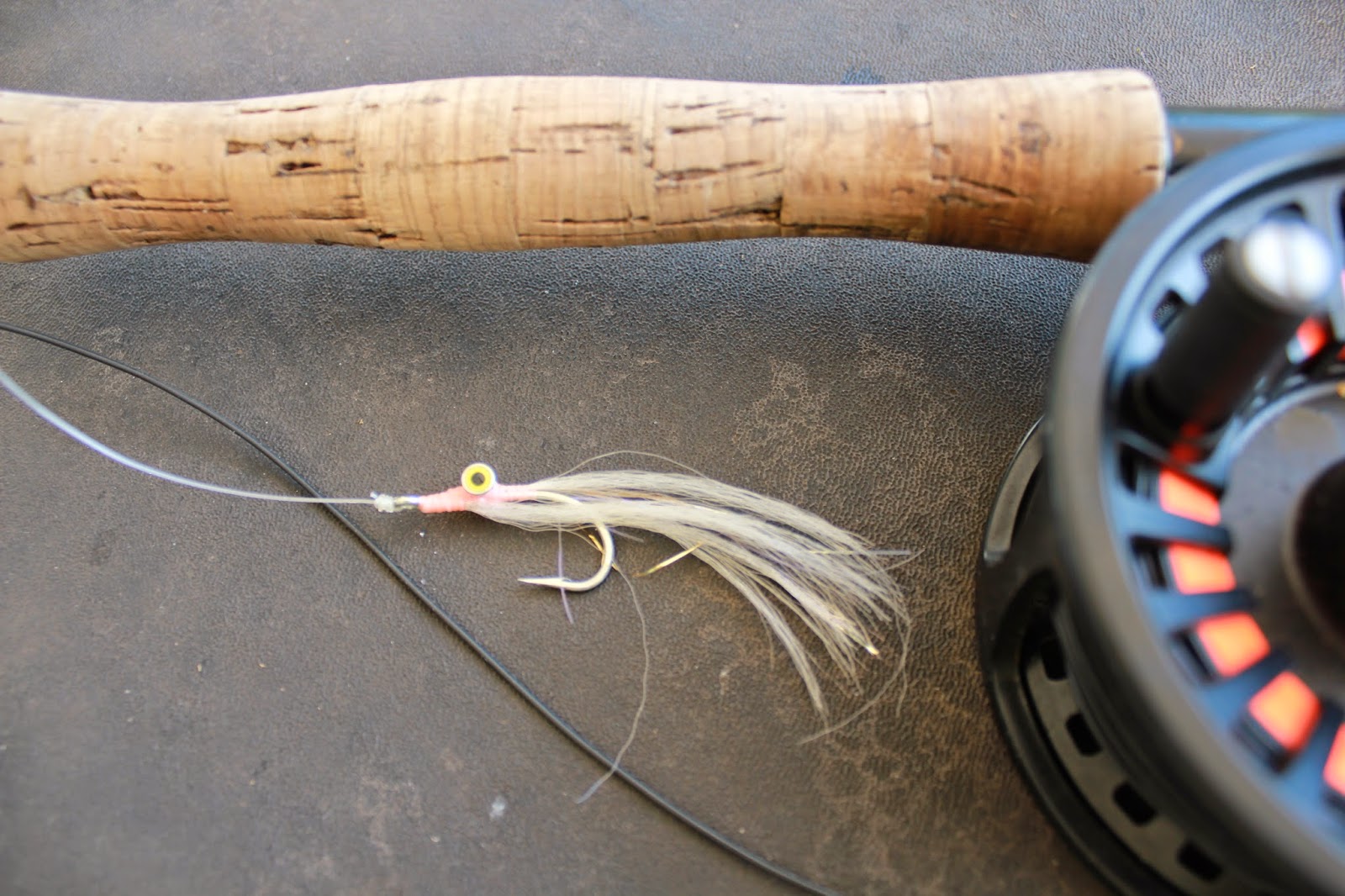
Will be my favourite TFO 7w rod rigged up with and clear intermediate line for the flats fishing applications and a barra thing fly tied on the leader (and a few scampi/squimp and crab patterns in a fly box in case blue bastards are around) 


Sage RPLx 8W Floating Line and Crease Fly

Rod 2#. 
Next rod is my 30year old Sage RPLx 8w, still going strong, that will be rigged for surface fishing with a floating line and a crease fly or a gurgler


TFO 8w Full sink line and Clouser
Rod #3. 
For the deep water applications a TFO 8w will have a full sinking line and a clouser on the end of the leader. For the early morning session will be a bead chain closer fly with a touch of green, later this will be changed to a clouser all white in colour. Bead chain eyes chosen as weight of sinking line will be sufficient to attain the depth needed (3-5m).


Targus 10w Full Sink line and BA-BC fly
Rod #4. 
Lastly, for the bigger fish that might happen by I will have my 10w rigged up with a SA tropic express. Alinr with an intermediate running line and 30 feet of fast sink tip. Pity they don't sell this line any more, love it. Just ordered some Rio leviathan line to replace the ones I have which are getting a bit tattered - hope it is as good.  I also will have a spare reel for the 10w with a floating line on it and a BIG popper ready to tie on in case of sustained surface action and big fish.


Still no word on my boat being fixed
Might have to see if a deckie position available on someone else's boat!